Tomorrow I’ll be getting another dose of Eribulin, which will wrap up cycle 2. I will have one more cycle before getting scans. As blood work and liver pain has improved, I am fairly confident that the scans will show improvement in my liver as well. I’m not out of the woods just yet, but things are on the right track. Just gotta cross my fingers that the LMD has remained stable during all of this.
After scans, I plan on asking my team if I can try again with qualifying for the clinical trial that I want to participate in. That’s always been my goal! Just as an FYI, the clinical trial I want to participate in would put me back on a drug categorized as an antibody drug conjugate (ADC). I have been on two ADCs (Enhertu and Todelvy/Saci) in the last year. Although I haven’t been an exceptional responder to these drugs, I have gotten an average time on them and have tolerated them fairly well, especially the Saci. The paper I recently had published emphasized the importance of studying and understanding the patient’s experience and why research needs to continue.
Speaking of which, my desire to participate in research/clinical trials has led me to being asked to participate in an upcoming event. I was asked to be a patient voice for a panel that will do a “flash” ask for donations for MBC research, specifically targeted at ADC research. My perspective as a patient that has experience with these drugs will hopefully bring a personal connection to research and hope for the future, and ultimately some large donations in for funding this research.
I will come back soon and report how the event went. XO
In March I had scans and they looked stable. The LMD and brain mets looked tiny still, which is always a HUGE relief. My liver lesions showed a little growth and a little shrinkage, but overall, nothing too dramatic that would cause me to need a treatment change at that time. The liver function tests (LFTs) were sort of trending up, but there wasn’t anything dramatic. My doctor and I decided we would go forward with the same treatment I had been on and scan again in six weeks. At that appointment we also discussed what would come next in the treatment line-up — one option being a clinical trial that included LMD patients. I was excited about that because usually LMD patients are excluded from trials (long story short, it’s about funding and FDA approval). Changing treatments is never a fun talk to have, but I was excited about the idea of participating in research again.
About three weeks after those scans I woke up from a nap one day with very swollen and painful lymph nodes in my left arm. A call in to my oncologist and we decided we needed to scan again and soon.
The results of that scan, just three weeks after the March scans showed that the liver lesions had grown, just a little, and the recommendation was to get a liver MRI to confirm the extent of the growth.
I haven’t spoken much about what types of scans I get and why, but insurance is a big reason I get only CT scans now, even though my doctor would like me to get liver MRIs regularly, since that is a location I have active cancer. My insurance has denied my request to get liver MRIs time and time again. CT scans are great for a general picture of the body and can be used as a measurement tool to track growth, but they are not finely focused and can show a lot of image noise when looking at a specific organ. So in my mind we could have had definitive evidence of progression a few weeks ago if I had been approved for a liver MRI and I would have made a different choice about treatment at that time.
While my doctors office was sorting out scans with insurance, we were also working on getting me qualified for this clinical trial. It was clear that it was time to move treatments as my LFTs and CT scans continued to trend in the direction of progression, albeit small at that point. I was also starting to have increased pain in my liver as it started to become inflamed and angry.
I signed my trial informed consent, started doing blood work, scheduled the other tests needed for a baseline for the trial, and was ready to rock last Thursday. Unfortunately, cancer had other plans for me. My LFTs came back WAY too high, even my bilirubin which has always been stable and normal for me was elevated. This was alarming. My doctor asked me to come back to Boston on Monday to have my labs drawn again. This time the LFTs came back even more elevated than before. I wasn’t going to qualify for the trial, and my doctor didn’t want to wait any more days to start treatment. We were worried, I was in pain, and I had been off treatment for several weeks at that point.
On Monday of this week I started an IV injection chemo called Eribulin. It’s an older chemo, but was used quite frequently before the last five or so years when a lot of these new chemos were approved. To be honest, I don’t have a deep knowledge about it besides what we went over in my chemo education appointment. Side effects seem like most chemos — some GI issues, hair loss (already lost that), fatigue (just pile more of that on), low blood counts (like red and white cells), and neuropathy. There aren’t many times where I feel like I don’t really have a choice in treatment options, but this seemed like one of those times. I could have refused treatment, or delayed it more, but if I wanted to keep going with a treatment this was my option. So I took the advice of my dear friend Moni (may she RIP) and said LFG.
And while all of that was happening, I also was able to get that liver MRI approved by insurance and had that scan on Tuesday. Bad news there…more than 70% of my liver is now covered in lesions. The plan is to keep a very close eye on my liver. I will be monitored weekly with blood tests to see if my liver function starts to trend back towards normal and we will scan in six weeks. If in the meantime the liver function doesn’t trend back towards normal we will change treatments yet again and hope and pray that I don’t go into liver failure.
If you see me around and I look yellow please let me know 🙂
And this is the tricky riddle of having metastatic breast cancer. A year ago I was changing treatments because the liver was acting up, but it eventually responded to treatment, with all LFTs heading in the right direction and scans looked good. In the fall my liver was cooperating and stabilized while we scrambled to treat and stabilize the LMD and brain mets. Now it’s the other way around again. We don’t have research to show how LMD or brain mets respond to Eribulin, so that’s a little scary. Hopefully I will continue to see residual benefits from radiation and previous chemo in the brain for weeks or months to come so that my liver has a chance to respond to Eribulin.
Please keep the good vibes, thoughts, and prayers coming my way. I’d love to give you all some good news in a few weeks when I get scans again.
Thank you to everyone for reaching out and checking in with me, Andrew, other family members, and the close friends who have been on-call for us these last few weeks. It’s been a hectic, busy, and an overwhelming time — especially the last week or so.
During the first two weeks post-radiation, I was able to recuperate with a relative lack of chaos. Still, even in the somewhat stable days, many moving parts were being coordinated and researched. I was doing that with a brain that still isn’t cognitively 100% and all of the other side effects I wrote about in the last post.
But I have made progress, logistics are falling into place now, and a plan is coming together that makes sense and gives me some hope. Let’s get into it! The good, the bad, and the ugly…except not in that order.
The Ugly — When I was first told about Leptomeningeal Disease (LMD), I didn’t fully comprehend what was being thrown my way. It was entirely out of left field, and I have learned throughout August that LMD is rare — only 3-5% of all breast cancers metastasize this way, and in my subtype of breast cancer (hormone positive, HER2-), this is even rarer. We are dealing with a unicorn here, not in a good way. LMD is extremely serious and dangerous. The rapid response to getting my treatment started was appropriate for a reason. My personal LMD is also acting exceptionally aggressively, and we don’t know why. If we can’t get control of this disease quickly, this is the worst-case scenario. We have now jumped the queue on other treatment options that work well in other parts of the body to mainly focus on the LMD because I am symptomatic, and it’s spreading.
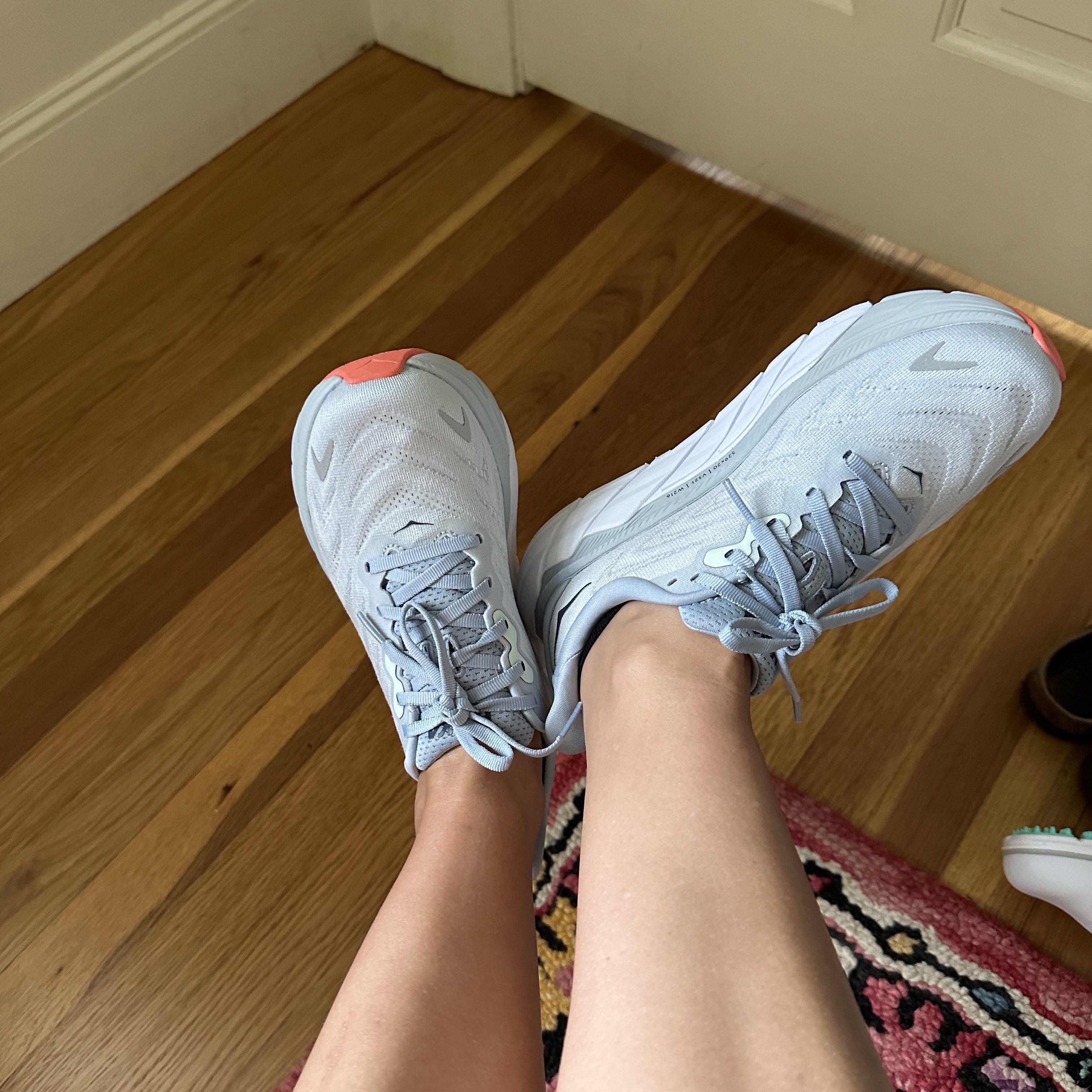
The Bad — it’s spreading. Yeah, after whole-brain radiation and a dose of Doxil, I continued to have symptoms. My feet continue to experience numbness and tingling, which isn’t resolving. I bought myself a pair of “stability-sneakers” to walk more efficiently and comfortably. At least they aren’t wicked ugly! haha! I also continue to feel off balance and have weakness in my legs and arms. My doctors have said these symptoms are the cancer taking root in my spinal cord, not the effects of the steroids or treatment. The steroids cause my jitters and cloudy mind, but anything else is really cancer itself. The scan I had two Fridays ago confirmed that the LMD was more visible and that the cancer now has left lesions on the cord itself. Not good.
New sneakers
Getting a lumbar puncture so that we can learn if the cancer has mutated or changed in some way. Trying to figure out why it’s so aggressive.
The Good — Now, here is where the plan and the hope come in. When considering treatments when first given the LMD diagnosis, two types of radiation were presented to me. Traditional X-ray or photon radiation to the whole-brain or proton radiation therapy. Conventional whole-brain radiation has been the standard of care for a long time and is a good option when you want to treat the whole brain because the radiation beams will not hit any other organs and will only impact the brain. Cool cool, that makes sense. But when we are talking about radiating the spinal cord, if traditional radiation is used, it goes beyond the cord, and the beams will hit the heart, lungs, digestive organs, bladder, etc. Some severe side effects come along with that, which is why traditional radiation to the spine isn’t preferred.
Proton therapy, on the other hand, has this unique ability to stop radiating at the tissue that you want it to treat, avoiding other things like those organs we want to protect. It’s very promising. Proton therapy also has a better efficacy with LMD, potentially extending my life by months, not weeks, and offering a better quality of life. So why didn’t I do proton therapy to start with? It’s not as widely available, it takes longer to map/simulate, and insurance always denies it before approving it, so that process takes TIME. I didn’t have time on my side when I was given the news. Remember, I said that if left untreated, LMD can be deadly within weeks.
There are not a lot of proton centers around the USA. There is one at Mass General (MGH) in Boston, but they refused to take me on as a patient because they don’t like to split up brain and cord treatment, and their list of waiting patients is quite long. So, I started digging elsewhere. I found that there are less than 40 centers in the country that can do proton therapy, and since this is me, I wanted to look at the best ones first. My radiation oncologist said if I could find a place to take me on as a patient, he would support it, but if I couldn’t, we couldn’t wait much longer, and my only option would be doing traditional radiation to the spine next week.
I have reached out to four centers, and eventually, one in New Jersey worked quickly and said YES to taking me on as a patient. The center is called ProCure and is in Somerset, NJ. They are given a lot of overflow patients from Memorial Sloan Kettering (which, like MGH, has a long wait list). They have been great about working with my insurance and expediting my case. The whole process has been overwhelming yet smooth with them, making me feel like my efforts are moving me in the right direction. This puzzle piece is coming together.
Right now, the radiation plan is that I will go down to NJ this coming week with my sister-in-law on Tuesday/Wednesday via train (I still can’t fly as my seizure risk is still thought to be elevated). This initial appointment will be for mapping/planning/radiation simulation. After the doctors collect all the information they need, they can do all of the calculations and get me started on 10 daily treatments beginning Monday or Tuesday of the following week. I will need to set up shop in NJ for 5 days at a time, and I’ll come home the weekend in between.
It’s a huge sacrifice for my family to support me in this, and I am so grateful for their willingness to see the hope this treatment offers, too. Andrew will remain in NH with the kids. My in-laws and close friends have been pitching in with childcare, rides, and support. We added dates to the meal train to help Andrew, too. One of my sisters and one of my brothers will split their time in NJ with me, so I have accompaniment. My mom is coming to NH to help out as well. I cannot express enough how much this all means to me. This isn’t for the faint of heart. In addition to my own Cancerland stuff, we still have a very active and full life, including my son starting a new school this fall, his 9th birthday, fall sports, music, and other activities. It’s A LOT, A LOT – ALOT.
Dr. Tolaney and me before the Jimmy Fund Telethon interview we did last Wednesday
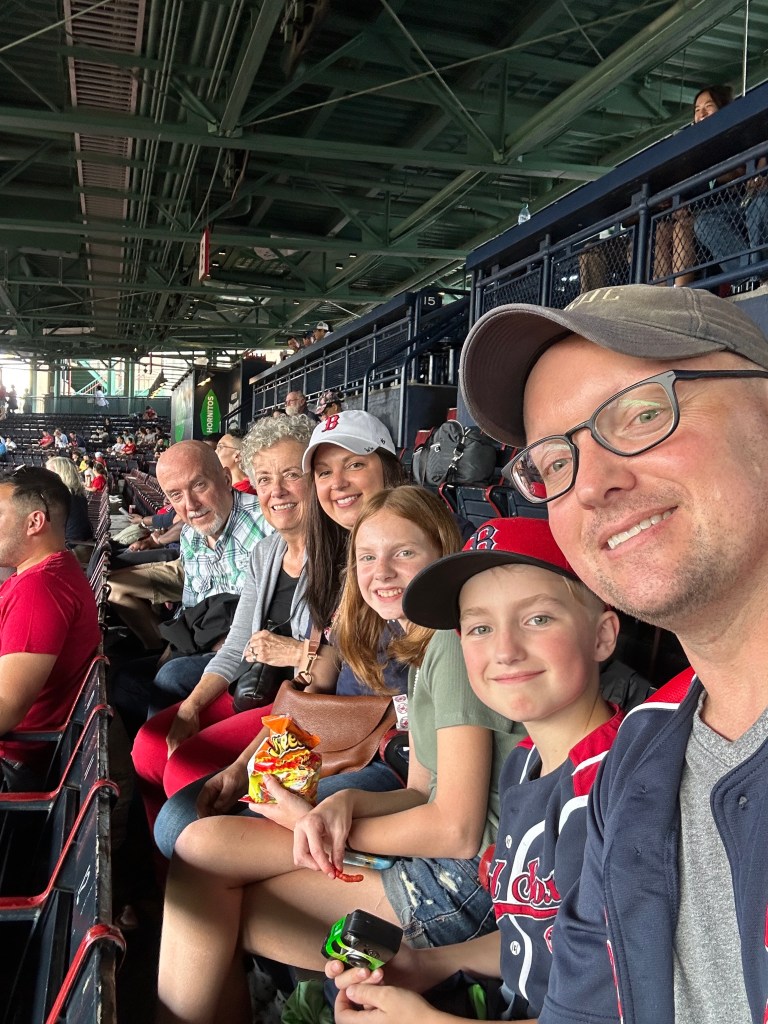
At the game after the Jimmy Fund Telethon interview. What a fun way to say goodbye to summer!
Radiation is targeted, though; we must treat my body systemically, too. Doxil was clearly not working because the LMD grew, and according to my CT scan done last Thursday, the lesions on my liver, that were improving on Taxol, also started to grow again. Out with Doxil and in with something new.
My oncologist wanted to start me on a new chemo before radiation. Still, timing is tricky because I needed about a week of “wash-out” between chemo and radiation so that I wasn’t miserable with side effects. I was scheduled to get Sacituzumab (AKA Saci or Trodelvy) this Thursday, but I got a call yesterday saying they could fit me in today (Sunday) for a treatment. I jumped at the opportunity and received my first dose of Saci.
The chemo itself is a cousin of Enhertu (was on from January 2023 to May 2023), but it has shown to be a very effective drug at crossing the blood-brain barrier and hitting really aggressive breast cancer. It’s a heavy hitter though, and requires many pre-meds. I expect to have side effects around day 3-4 and last a few days. I am told I can expect nausea, maybe vomiting, diarrhea, fatigue, hair won’t be coming back on this one, low white blood counts, etc. You know, all of the things we think of come along with traditional IV chemotherapy.
If you’re still here reading this, I appreciate it. I will always try to text or message you back if you reach out; it might take a day or two. Please continue to send those prayers and good vibes my way. I am not asking for a miracle, just manageable side effects and a little more time with my loved ones.
Greetings to all of you followers! I have been taking a big step back from regular updates in order to really be present in my normal day to day life. It’s been a nice break! Just because I haven’t been posting doesn’t mean things haven’t been happening in Cancerland though. Just the opposite actually. Nothing terrible, but it hasn’t been dull.
I’ll give you a quick recap to get you up to speed, and then I will let you know where I am at today and why this post is called MBC Day. So back at the beginning of 2020 I was having some lung inflammation (likely due to the immunotherapy) which was a bummer because it wasn’t getting better after a break from my immunotherapy. Then COVID hit, and we decided that if I were to stay on the immunotherapy and my lung inflammation continued to worsen that would put me at even hirer risk for comorbidity issues if I were to catch COVID. So I have officially been taken off the immunotherapy, but I am still in the clinical trial and still take my daily oral medications (abemaciclib and anastrozole).
In May, I started experiencing almost debilitating indigestion. I would do a few weeks on omeprozole and taper off to see if that would fix the indigestion long term. Nope nada. I tried Pepcid AC and tums and still the indigestion would come back. It not only wasn’t going away completely, but it was coming on with intensity more frequently. I kept track of what I as eating and drinking and how I was sleeping. I was uncomfortable often and nothing seemed to trigger the indigestion. I started working with a GI doctor at Brigham and Women’s Hospital that specializes in immunotherapy related GI issues because my doctor didn’t know if what I as experiencing was as a result of the immunotherapy I had been on previously, or if it was as a result of the abemaciclib. I tried a break from my abemaciclib. The frequent runs to the bathroom definitely cleared up with a break from the abemaciclib, but other than that I had very little relief from the indigestion. The next step was to do a bunch of blood tests and head in for a upper and lower endo scope.
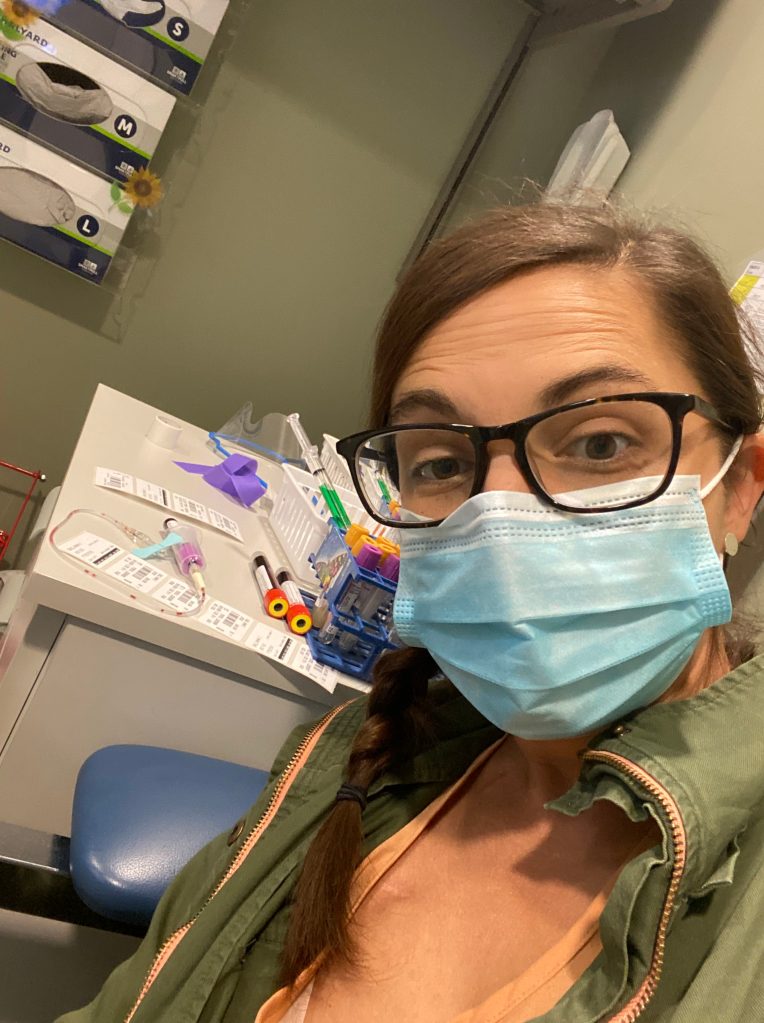
Local blood draw! So many tests!
I ended up being told I had a C-Diff infection which was a surprise to say the least, and I am not even sure that it was truly a full blown infection. That’s another story all together, but at the end of the day I took a course of antibiotics to kill off the C-Diff infection. After that I went and had an upper endoscopy and a colonoscopy. The results of the scopes showed a delayed immune response likely due to the immunotherapy. The gift that keeps on giving! Yes immunotherapy is amazing and has huge promise, but it also comes with big risks — this being one of them. At any point in time my body could see itself (instead of the cancer) as the enemy.
Drinking my colonoscopy prep. Yuck!
I am now on a steroid that is supposed to calm my GI tract, a new anti-diarrheal medication that has less side effects than immodium, and I am back on omeprozole. I can say I actually feel pretty good, but this added a shit ton of drug coordination and number of pills to my daily load. If I don’t time everything just so, the whole day is off and then I worry about how I will feel. I went to my oncologist to talk about this because it was overwhelming. But my schedule is generally this:
6:15am Thyroid medication (remember immunotherapy killed my thyroid): 1 pill
6:45am omeprozole: 1 pill
7:30am breakfast (has to be timed just right with the thyroid med and the omeprazole)
8:30am abemaciclib: 3 pills
10:00am steroids and anti-diarrheal: 4 pills
8:30pm abemaciclib and anastrozole: 4 pills
Bedtime: anything I need for sleeping because steroids.
Thats a minimum of 13 pills everyday. I am a person that before cancer took nothing, so that’s a huge jump for me. But now that I have a schedule it’s mostly manageable. The pills added to deal with the GI stuff are hopefully not in my treatment plan indefinitely, but for now there is no end in sight. The steroids take 6-8 weeks to really show an effect. I am coming up on week 6 with them so hopefully my most recent scans will show some improvement on the inflammation in my small intestine and stomach. Once the inflammation is calmed down I will taper off of the omeprozole and see how my gut feels.
If y’all know anything about me, it’s that gut health is really important to me. I have been interested in healthy gut flora for a long time, so being on all of these medications for my gut feels so bizarre. But I don’t believe that some miracle water, some supplements, enzymes, or probiotics will fix this issue. We needed to hit the reset button and see where that takes us. I’ll keep you in the know about how it goes for me.
And this all takes me to why is the post called “MBC day!”? Well it is because October 13th is the one day out of Breast Cancer Awareness month specifically designated to MBC Awareness. And if I have done my job at all, as a patient and advocate for MBC, you will know this is NOT enough and we need more: more publicity, more knowledge, more research, more funding. My story is just one of the thousands of MBC stories. And my story isn’t pink or pretty or “Rah Rah for your Ta Ta’s” (yes I have seen this statement made). We need real funds and real research to find a cure for breast cancer. Early stage breast cancer doesn’t have a cure. Yup I said that. Here’s my reasoning: early stage breast cancer doesn’t have a cure because breast cancer as a whole doesn’t have a cure. If you have MBC it is most certainly a death sentence (average life expectancy is 3-5 years after diagnosis). And if there isn’t a cure for MBC there isn’t a cure for breast cancer. Find a cure for MBC and we can say there is a cure for breast cancer. So for those women diagnosed with MBC right from the get go (called De-Novo) or for the 30% of us early stagers that will reoccur with MBC please consider donating money to Metavivor. More money to research means more research and progress for a cure.
Tonight the #lightUpMBC program is happening at 8pm EST. You should have it on and tune in on Facebook Live.
I’m two years into this chapter and I am never giving up on getting more for MBC because even if I am doing well, there are many folks out there that aren’t. I have lost 5 friends in the last 12 months from MBC. Keep fighting the good fight my friends! I can’t do any of this without your support.





 Hannah in CancerLand