
*I want to be clear that I am not a medical professional. If you have any personal questions where medical advice is required, please seek out a medical professional*
In recent years insurance started covering routine screening mammograms for women over 40 years old. But what do those of us with breasts (women, men, trans, and non-binary folks — that’s all of us!) do before age 40 and between screenings? Also, are mammograms our only option? I hope that this first breast health post helps to answer some questions.
Personal recommendations
My number one recommendation is to get to know your body. You are your biggest advocate; no one should know your body better. Self-breast exams are exactly how I found both of my tumors. If I didn’t know what my own chest felt like, then I wouldn’t have been able to tell my doctors something was different, off, not my normal.
And to be honest, there are plenty of women I know that go to their doctor saying, “This doesn’t feel right,” and their doctor disregards their concerns because they are “too young” or “not at high risk,” or whatever else they have been told. If you know your body, you can push back, you can advocate, you can get an answer. But if you leave the knowledge of your body up to someone else, you are giving up bodily autonomy.
Actually, I want to take a second to give a shout-out to both my mom and my sister, Heather. My mom used to hang this shower tag in our shower that showed me how to do a self-breast exam. I was a teenager and I didn’t take it super seriously, but I can still see the pink, black, and white images and I remember thinking I guess I’ll do this a few times a year and be okay. I appreciated that unspoken encouragement to take my breast health seriously. Heather, on the other hand, was more outspoken when it came to healthy bodies. She was the one that told me I needed to make sure I knew my body before anyone else knew my body. That went for both breast health and sexual health. And while I am here, I want to say that I have known two people (not associated with my cancer community) to find their own cancers in their genital areas because of self exams/knowing their bodies and their normal. Knowing your body is empowering and enlightening.
Since this post aims to inform about breast health, let’s get back to that topic. Breast exams are something we need to do more than a few times a year. Teenager Hannah was wrong to think that a few times a year was enough. In fact, if you have breasts (remember that’s everyone) you should be doing these self-exams once a month, around the same time every month, so that you’re feeling the breast tissue in about the same place in your monthly cycle (if you have one). There is a social media movement called #feelitonthefirst which, is just a nice reminder to do your self-breast exam every month on the first day. Sometimes you might feel a lump/bump one day and not feel it a few days later. Our tissue changes throughout the month, so the rule of thumb given to me by my first oncologist was self-exams once a month and not too close together or we will never notice a change, or we will notice every little change. So my second recommendation is self-exam once a month, and changes are normal.
I want to reiterate too taht EVERYONE should be doing self-exams throughout their whole lives — flat chested, with or without mastectomies, with or without reconstruction, health breasts, men, women, teens, postmenopausal folks. All of you!
Self-breast exams
How do you perform a self-breast exam? What are you feeling for? What is normal? What is not?
I will provide a few pictures to help guide you, but honestly, head over to Instagram and look at the tag #feelitonthefirst or #selfexamgram, and you will see many great videos on how to do these exams. My particular favorites are by @dearcancer_itsme (does them with her kids and she’s flat chested after having implants out), @ihartericka (she is post-mastectomy, has no nipples, and does hers without a shirt on which I find helpful), and @allynrose (she does some laying down, standing, and talks you through stratagies).
To begin, look in the mirror with your shirt off. You’re looking for any physical abnormalities such as dimpling, lumps/bumps, discharge, puckering, or skin changes. Make sure you’re lifting your arms up as well as looking while your arms are down. Sometimes changes don’t appear until the skin or tissue is stretched tighter.
Next, feel those breasts! You can do this in the shower or in front of the mirror. There are a few different methods for feeling the tissue, but I personally like doing the wedge and rubbing rather than tapping. You will see both rubbing and tapping used, it’s just a matter of preference. I will use the tapping method more on my neck, clavicle, and sometimes underarms. Do whatever method is comfortable for you and helps you feel all of the tissue.
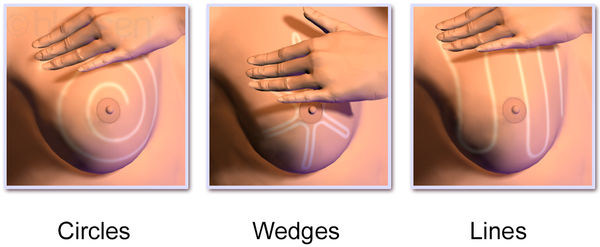
Finally,as a reminder, you have two breasts, so do the exam on both sides. You’re feeling all the up into your neck, under your arms, and into those armpits, your sternum, and of course, the breast tissue. If you wear a bra or are familiar with where a bra would wrap around your sides, that’s all potential breast tissue.
The what if
Now what do you do if you find something like a lump, puckering, skin change, etc? Do not panic, like seriously. Remind yourself that most of these things are benign. Do another breast exam in a week or so and see if there have been any changes to that area. If the change in your tissue has grown bigger, is swelling and tender, or doesn’t resolve itself in one to two weeks, make an appointment with a GYN or PCP. It’s never too early or too late to get some professional eyes and hands on something of concern. I personally went to my GYN when I found my first lump because I was still breastfeeding and figured they would know breasts best at this stage of my life. With the growth on my sternum (second diagnosis) I was seen by my oncologist.
My first lump felt like the size of an almond, pretty firm, and was sort of stuck in place on my rib at about 6 o’clock on my left breast. I made sure to let some friends feel it before I had it taken out. As uncomfortable as that was, sharing that experience, it was just the start of me trying to help others advocate for themselves and their bodies.
What if you get it checked out, and your doctor is concerned? Usually, the provider will order a diagnostic mammogram, an ultrasound, or maybe even a biopsy. For my initial diagnosis, since I was breastfeeding, a mammogram wasn’t performed right away. Essentially a breast with milk in the ducts will just look like a while mass of tissue. Impossible to read. So instead I was recommeded to get an ultrasound and when that showed concerning features, I was then recommended to get a needle biopsy. The biopsy results then confirmed that the almond-sized lump was indeed cancer.
Again, I want to reiterate that a lump doesn’t automatically mean cancer. I wasn’t even thinking that the biopsy would show cancer. I was sure I was going to be told I had a fibroadenoma or a cyst because I have always had fibrous breasts and I knew I wasn’t at high risk for cancer.
Things turned out differently for me, but I still beleive that most of you will be okay. Just make sure you take your health seriously. If you are worried or not comfortable, find someone who will listen and get to the bottom of the concern.
Screening or diagnositc options
Mammograms aren’t our best option out there. You have probably heard me say this before. If you are at high risk for breast cancer, you are young and have had a concern or concerning mammogram, or you’re breastfeeding and need screening, then do not settle for a mammogram only. Please ask your provider to give you a breast MRI, and ultrasound, or now something new is a breast CT. I cannot wait for the breast CT to come to our local area. Breast MRIs can be problematic because they are extremely sensitive and can give false positives, which can force someone into getting a biopsy that shows that the lump/bump is actually negative for cancer. This can be stressful and unsettling. Ultrasounds are good if you’re looking at specific place in the breast, but aren’t great for looking at the whole breast. I don’t know much about the breast CT yet, but what I have read is that they are pretty fast and easy like mammograms, but without the squeezing. That sounds promising.
Most premenopausal folks will be told they have dense breasts, which is another hard thing about mammograms. They just don’t pick up on the very small details that are hidden in dense breast tissue. If you are told you have dense breast tissue, I highly recommend that you ask about alternating mammograms and MRIs for screening.
What else do you want to know?
Comment below if there is something you want to know more about. I want to make sure you’re getting trusted and meaningful information!
 Hannah in CancerLand
If we have been getting diagnostic yearly mammograms due to a previous concern and they say – we are switching you back to screening mammograms – is that ok or should we insist on continuing the diagnostic?
LikeLike
Prob a better question for your provider. My guess is that at some point once you have had “enough” clear diagnostic scans you get moved to screening again.
LikeLike
This is awesome information. Listen to your body, do the self-exam! We are our own healthcare advocates. I had a scare a few years ago and did not feel a lump on my monthly exam. I am so glad I knew the questions to ask and was insistent that my PCP (who is in BC remission) order an MRI. Turned out to be nothing but it was scary!
“According to the National Cancer Institute, based on current incidence rates, 12.9% of women born in the United States today will develop breast cancer at some time during their lives1. About 85% of breast cancers occur in women who have no family history of breast cancer2. Approximately half of breast cancers develop in women who have no identifiable breast cancer risk factor other than gender (female) and age (over 40 years),” BreastCancer.org; https://www.breastcancer.org/facts-statistics; August 1, 2023.
LikeLike